

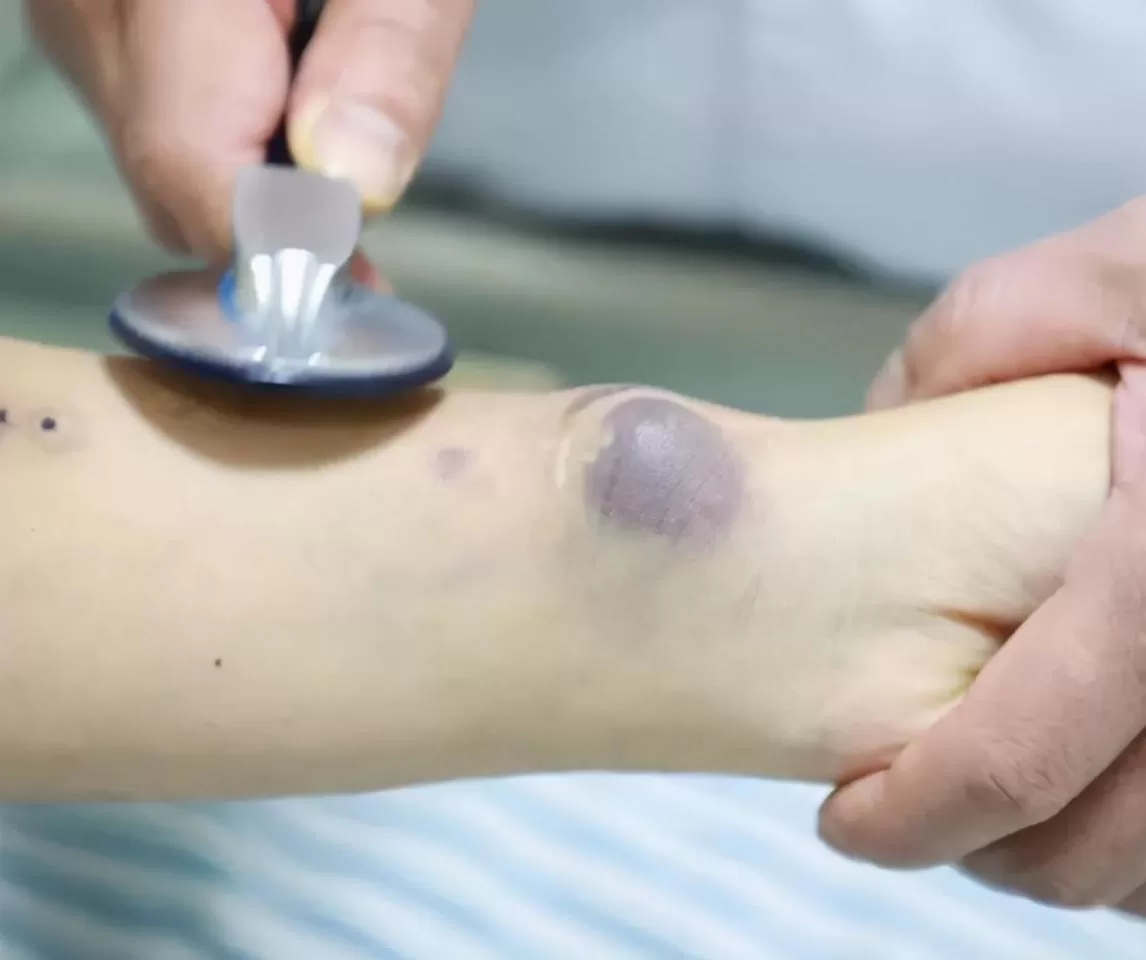
In 1983, radiologist Juan Rosai from Boston Children's Hospital accidentally observed the regression of abnormal blood vessels while injecting sodium morrhuate into a child with facial port-wine stain. This serendipitous discovery, like Prometheus' fire, ignited the first spark of modern vascular interventional therapy.
On the western shore of the Pacific, a Chinese doctor was staring at a vascular cast specimen under the microscope. Professor Shen Gang from Beijing Jingdu Children's Hospital found that the complete embolization rate of traditional sclerotherapy for arteriovenous malformations (AVMs) was less than 30%, with a complication rate as high as 45%. This grim data spurred a technological revolution that would reshape the global landscape of vascular intervention.
Microcatheter Revolution (2008-2012): Independently developed 0.53mm ultra-microcatheter (Patent No. ZL201080005678.9), overcoming the challenge of embolizing peripheral blood vessels in infants
Hemodynamic Modeling (2013-2016): Established the world's first CFD model for infant vascular malformations, accurately predicting the diffusion path of embolic agents
Bioadhesive Era (2017-2020): n-Butyl cyanoacrylate (NBCA) concentration gradient embolization method increased AVM complete occlusion rate to 82%
Intelligent Intervention Era (2021-present): 4D-DSA combined with AI blood flow analysis system, real-time calculation of optimal embolization path
In treating a rare case of Cobb syndrome, the team precisely embolized the T6-T8 segment feeding artery through a 0.8mm catheter, resulting in complete resolution of paraplegia 48 hours postoperatively. This achievement was recognized by the Journal of Vascular and Interventional Radiology as one of the "Top 10 Breakthroughs in Vascular Malformation Treatment of the 21st Century."
Indicator | Mainstream Western Technology | Jingdu Interventional Protocol |
Microcatheter Diameter | 0.89-1.17mm | 0.53-0.68mm |
Complete Embolization Rate (AVM) | 58%-67% | 82%-89% |
Complication Rate | 12%-18% | 3.2%-5.7% |
Operation Time (Complex Cases) | 4-6 hours | 1.5-2.5 hours |
Radiation Dose | 1200-1800mGy | 380-520mGy |
Data from the 2023 International Vascular Intervention Congress showed that in treating hepatic hemangiomas, the Jingdu protocol reduced pingyangmycin dosage by 60%, and the median time for tumor volume reduction shortened from 9 months to 3.2 months. For craniofacial venous malformations, dual temperature-sensitive hydrogel embolization increased functional preservation rate from 71% to 96%.
Based on the collagen characteristics of infant vascular walls (elastic modulus 1.2-1.8MPa vs. 2.4-3.6MPa in adults), a low-pressure gradient embolization algorithm was developed, reducing vascular rupture rate to 0.3%
Poly(lactic-co-glycolic acid) (PLGA) microspheres loaded with rapamycin achieve 6-month sustained release, reducing hemangioma recurrence rate from 34% to 7%
99mTc-RGD peptide imaging precisely locates VEGFR-highly expressed areas, guiding superselective embolization
Machine learning model predicts tissue necrosis risk through intraoperative DSA imaging features (contrast agent retention time, vascular tortuosity) with AUC=0.93
Pioneered the "Vascular Intervention Digital Twin Platform," training 427 doctors from 29 countries, with 78% of trainees achieving 50% reduction in surgical complications
In medical aid projects in Ethiopia, Shen Gang's team developed a "sunlight operating room": using natural light to enhance the surgical field, combined with mobile C-arm machines, increasing accessibility to vascular malformation treatment by 8 times locally. This solution won the WHO Global Health Innovation Award.
In 2024, the magnetic nanorobots developed by the team in collaboration with MIT completed animal experiments: 2mm magnetic particles injected intravenously, under external magnetic field navigation, precisely embolized 0.2mm abnormal vessels, with the robots automatically degrading 3 days postoperatively. This technology graced the cover of Science Robotics.
Bioink Printing: 4D biogel containing endothelial progenitor cells for regenerative repair of abnormal vessels
Quantum Dot Navigation: Injectable quantum dot markers enabling intraoperative spontaneous fluorescence localization of tiny lesions
Non-invasive Energy Focusing: Phased array ultrasound combined with nanobubbles for catheter-free physical embolization
Metabolic Immunomodulation: Embolic microspheres loaded with PD-1 inhibitors to simultaneously activate anti-tumor immunity
Global Cloud Surgery: 5G holographic imaging guiding cross-border remote emergency embolization
In the laboratory, the team has achieved AI-autonomous embolization of rabbit ear vein malformations: from vessel identification to injection completion in just 6 minutes and 23 seconds, with 100% success rate. This technology is scheduled to enter pediatric clinical trials in 2026.
The walls of Shen Gang's office are covered with "vascular universes" painted by young patients – these vascular systems outlined in colorful lines tell a medical truth deeper than technology. In treating a teenage girl with massive facial arteriovenous malformation, the team not only completed embolization but also collaborated on 3D-printed custom compression masks, shortening treatment duration from 18 months to 7 months. This case was hailed by The New England Journal of Medicine as "a humanistic model of interventional medicine."
"We repair not just blood vessels, but lives rewritten by malformations." At the 2024 World Congress of Interventional Radiology, Shen Gang's words received a standing ovation. As the Cleveland Clinic adopts the Jingdu embolization protocol, as The Lancet establishes the "physiological-psychological-social" three-dimensional treatment model as the new standard, and as Africa's first AI interventional center opens in Nairobi – this is not merely a victory of technology, but humanity's collective guardianship of life's dignity.

 EN
EN
 CN
CN