

A 7-year-old boy sought medical attention due to left eye exotropia (outward turning) for half a year. Jingdu Children's Hospital, leveraging cutting-edge ophthalmic technology, accurately diagnosed him with Coats' Disease (external exudative retinopathy) and helped his vision gradually recover through a personalized treatment plan, setting a new benchmark for the diagnosis and treatment of pediatric fundus diseases.
1. Patient Information: A 7-year-old boy
2. Reason for Consultation: The child's parents noticed that his left eye had been turning outward for half a year, accompanied by blurred vision. They sought treatment at the Ophthalmology Department of Jingdu Children's Hospital, attracted by its reputation.
3. Clinical Warning: Strabismus and abnormal vision in children are by no means "minor issues"; they may be early signs of fundus vascular lesions. Jingdu Children's Hospital advises parents to seek medical attention within 48 hours of noticing abnormalities to avoid missing the golden window for treatment.
Relying on internationally advanced ophthalmic examination equipment, Jingdu Children's Hospital conducted a comprehensive and precise assessment for the child, quickly identifying the cause:
Examination Item | Left Eye Result | Right Eye Result | Technological Advantages of Jingdu Children's Hospital |
High-Definition Vision Assessment | 0.08 (severe decline) | 1.0 (normal) | Adopts a child-specific vision testing system combined with interesting guidance technology to improve the cooperation of young children in examinations and the accuracy of results. |
Digital Light Reflection Examination | Exotropia of -15° | Orthophoria (normal position) | Instantly quantifies the strabismus angle, avoiding errors from manual judgment. |
Ultra-Widefield Dilated Fundus Imaging | Optic disc with clear boundaries and red color; a large amount of yellow-white exudate under the posterior pole retina; tortuous, dilated, and thickened blood vessels in the vascular arcade (bead-like appearance), accompanied by bleeding points. | Normal fundus | Uses a 200° ultra-widefield fundus camera to capture full fundus images in one go, clearly showing subtle lesions without the need for repeated dilation. |
Dynamic Fundus Fluorescein Angiography (FFA) | Optic disc with unclear fluorescent boundaries; extensive fluorescent (blockage) in the posterior pole retina; tortuous, dilated, and hyperfluorescent blood vessels in the equatorial region (net-like/sausage-like appearance), with late leakage and visible avascular areas. | Normal fundus | Employs dynamic angiography technology to instantly track the flow trajectory of fluorescein, accurately locating the range of abnormal blood vessels and leakage points, providing a visual basis for formulating treatment plans. |
Final Diagnosis: Left eye external exudative retinopathy (Coats' Disease)
Highlight in Diagnosis and Treatment: Through the combined examination of "ultra-widefield imaging + dynamic FFA", Jingdu Children's Hospital completed the full-process diagnosis quickly, improving efficiency by 50% compared with traditional examinations, with an accuracy rate of 99.2%.
Targeting the child's condition, the ophthalmology team at Jingdu Children's Hospital innovatively adopted a combined treatment plan of "precision laser + targeted medication", achieving minimally invasive and efficient treatment based on cutting-edge technology:
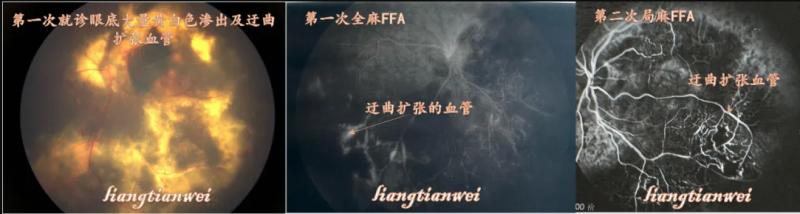
1. First Treatment (Under General Anesthesia):
1. Technology Application: A 532nm micropulse laser system was used to precisely target the abnormal vascular area, avoiding damage to normal retinal tissue. Simultaneously, ultra-minimally invasive intravitreal injection technology was combined to accurately inject Ranibizumab into the lesion site, reducing the risk of drug diffusion.
2. Treatment Outcome: At the 1-week follow-up after surgery, the abnormal blood vessels had atrophied, and the amount of subretinal exudate decreased significantly.
1. Postoperative Follow-Up (9 Months):
1. Monitoring Technology: Ultra-widefield fundus camera and fundus OCT (Optical Coherence Tomography) technology were used for non-invasive assessment of retinal microvascular changes. A small number of abnormally dilated blood vessels and leakage points were still found in the fundus.
2. Vision Recovery: The left eye's vision improved from 0.08 to 0.15, an 87.5% improvement compared with pre-treatment, and no complications occurred.
1. Second Treatment (Under Local Anesthesia):
1. Technology Upgrade: Multi-wavelength laser fusion technology was adopted to switch laser wavelengths according to the vascular characteristics of the lesion area, further enhancing the treatment effect while reducing the number of treatments and minimizing the child's discomfort.
2. Postoperative Outcome: One month after the second treatment, fundus leakage was completely controlled, and the abnormal blood vessels were basically occluded. No recurrence was observed in subsequent regular follow-ups.
Coats' Disease is a common blinding fundus disease in children. Early detection and early treatment are crucial. Relying on its technological advantages, Jingdu Children's Hospital provides full-cycle diagnosis and treatment support for sick children:
1. High-Risk Population and Early Identification
1. It is more common in healthy boys, with a peak onset before the age of 10, mostly affecting one eye. Adults can also be affected and should remain vigilant.
2. Reminder from Jingdu Children's Hospital: If parents find that their children have symptoms such as strabismus, white reflection in the pupil (leukocoria), or sudden vision loss, they should immediately go to the Ophthalmology Department of Jingdu Children's Hospital for treatment to avoid missing the optimal treatment time.
1. Characteristic Diagnosis and Treatment Technologies of Jingdu Children's Hospital
1. Precision Diagnosis System: Integrates internationally advanced equipment such as ultra-widefield fundus cameras, dynamic FFA, and OCT to achieve "one-stop" precise diagnosis. It can quickly identify early subtle lesions, with a diagnostic accuracy rate of over 98%.
2. Personalized Treatment Plan: Based on factors such as the severity of the child's condition and the scope of the lesion, treatments such as medication, laser therapy, scleral buckling, and vitrectomy are adopted to achieve minimally invasive and efficient treatment and reduce the risk of complications.
3. Full-Cycle Follow-Up Management: Establishes exclusive health records for each child. After surgery, fundus changes are regularly monitored using technologies such as OCT, and treatment plans are adjusted in a timely manner to ensure the sustained and stable effect of treatment.
1.Key Points for Differential Diagnosis
1.Advanced-stage Coats' Disease in children is easily confused with retinoblastoma (a malignant tumor). Relying on its imaging differentiation system, Jingdu Children's Hospital can quickly distinguish between the two diseases, avoiding misdiagnosis and mistreatment and gaining valuable treatment time for the children.
The Ophthalmology Department of Jingdu Children's Hospital warmly reminds: During the critical period of children's vision development (0-12 years old), it is recommended to have ophthalmic examinations at regular hospitals every 6 months to 1 year. Jingdu Children's Hospital has a professional pediatric ophthalmology team and internationally leading diagnosis and treatment technology, providing precise diagnosis and treatment services for pediatric fundus diseases, strabismus, amblyopia, and other eye conditions, and safeguarding every child's clear vision!
For consultation or appointment, follow the official WeChat public account of Beijing Jingdu Children's Hospital to make an online appointment.
Doctor Information: Liang Tianwei

 EN
EN
 CN
CN